
Security & Legal
Binance Account Restricted: Why It Happens and What to Do
What an account restriction on Binance usually means, the review processes behind it, what you can check yourself, and how to contact official support.
Seeing a restriction notice on your Binance account is stressful, especially when funds are involved. In most cases the message means some part of your account has been placed under a review process rather than closed permanently. Understanding what drives those reviews helps you respond calmly and avoid making the situation worse.
What "restricted" usually means
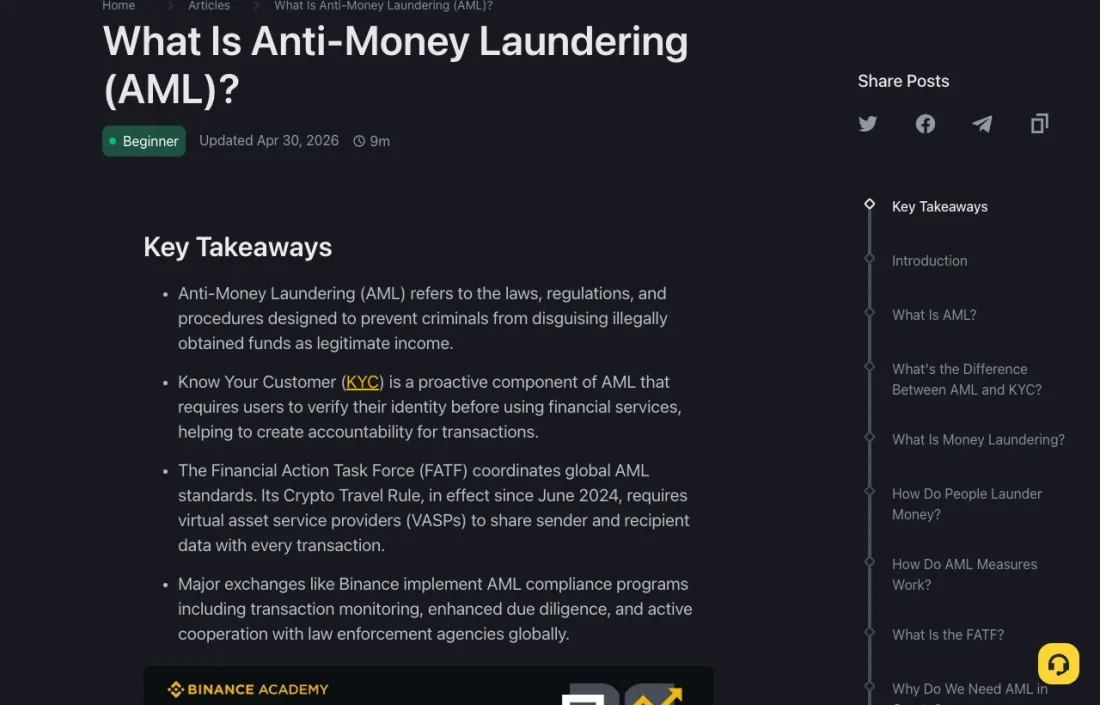
Exchanges operate under anti-money-laundering (AML) rules. Binance Academy's AML material describes the broad pattern: platforms run transaction monitoring, apply enhanced due diligence to higher-risk cases, and cooperate with authorities. It also notes that the Financial Action Task Force (FATF) coordinates global AML standards, and that its Crypto Travel Rule has been in effect since June 2024, requiring virtual asset service providers to share sender and recipient data with transfers.
A restriction is often the visible result of one of those processes. It can affect a single function, such as withdrawals or P2P trading, or the whole account. The exact wording, scope, and duration depend on your jurisdiction, your account history, and what triggered the review — none of which is published as a public rulebook.
Common categories behind a review
These are general categories, not a checklist that guarantees any particular outcome:
- Verification gaps. Identity or address information is incomplete, expired, or does not match what the account shows.
- Unusual activity patterns. Binance Academy's AML explanation gives examples such as large or unusual inflows and outflows, or a sudden spike in withdrawals from a normally low-activity account.
- Counterparty risk. Funds received from an address or a P2P counterparty that later becomes associated with a reported case.
- Regional or regulatory changes. Product availability and requirements differ by country and can change.
- Security signals. Login attempts from unfamiliar devices or locations, or an unresolved report of account compromise.
An automated flag is not an accusation. Binance Academy describes the sequence as flag, investigate and restrict, then report and recover where applicable — the middle stage is where most users find themselves.
What to check yourself first
- Read the exact notice. Note whether it names a specific function, a required action, or a case reference. The precise wording matters more than any general guide.
- Open Binance only from a bookmark or the official app. Restriction notices are a favourite theme for phishing messages.
- Check your verification status. If the account asks for updated identity or address documents, that request is the fastest path forward. Our guide to Binance proof of address covers what those documents typically need to show.
- Check your security settings. Confirm 2FA, registered email, and phone number are still yours and unchanged. If any looks unfamiliar, treat it as a possible compromise and act on that first.
- Collect your own records. Dates, amounts, counterparties, and transaction IDs for the activity in question. Having these ready shortens any support conversation.
What not to do
Do not open a second account to move around the restriction. Operating duplicate accounts can complicate your case and may itself breach the terms you agreed to.
Do not send documents, passwords, 2FA codes, or recovery phrases to anyone who contacts you privately offering to "unlock" the account. No legitimate exchange staff member asks for those in a chat. Our note on the Binance anti-phishing code explains one way to check whether a message really came from the platform.
Do not repeatedly resubmit the same incomplete information. If a review asked for something specific, supplying exactly that is more useful than volume.
Contacting official support
Use the Support Center reachable from inside your logged-in account or from the official website. Describe the affected function, the exact on-screen message, the approximate time it appeared, and any case reference the system gave you. Keep one thread open rather than starting several.
Response times vary with case complexity and jurisdiction. Compliance reviews involving third parties or legal requests are generally slower than a simple verification refresh, and support staff cannot always explain the details of an ongoing review.
Common questions
How long does a restriction last?
There is no published standard duration. A verification refresh you can complete yourself may resolve quickly, while a compliance review that involves outside parties takes longer. Treat any specific number promised by a stranger as a warning sign.
Can I still withdraw during a review?
It depends on the scope. Some restrictions affect withdrawals specifically; others leave them open. The notice in your account is the accurate answer for your case.
Does this mean my funds are gone?
A restriction is a hold on account functions, not an announcement about ownership. Follow the official process and keep your own records rather than acting on rumours.
Would moving to another exchange help?
It does not resolve an existing review on the restricted account. If you use more than one platform, our Binance and OKX comparison covers how the two differ for users in Vietnam, but the open case still needs the official process.
Sources and update note
This guide draws on Binance Academy's public AML explanation and the official Support Center. Requirements and processes differ by country and change over time; the notice and instructions shown inside your own account are the final reference.
Risk notice: This article is general education, not legal or financial advice. Account decisions rest with the exchange and the applicable regulator in your jurisdiction.